
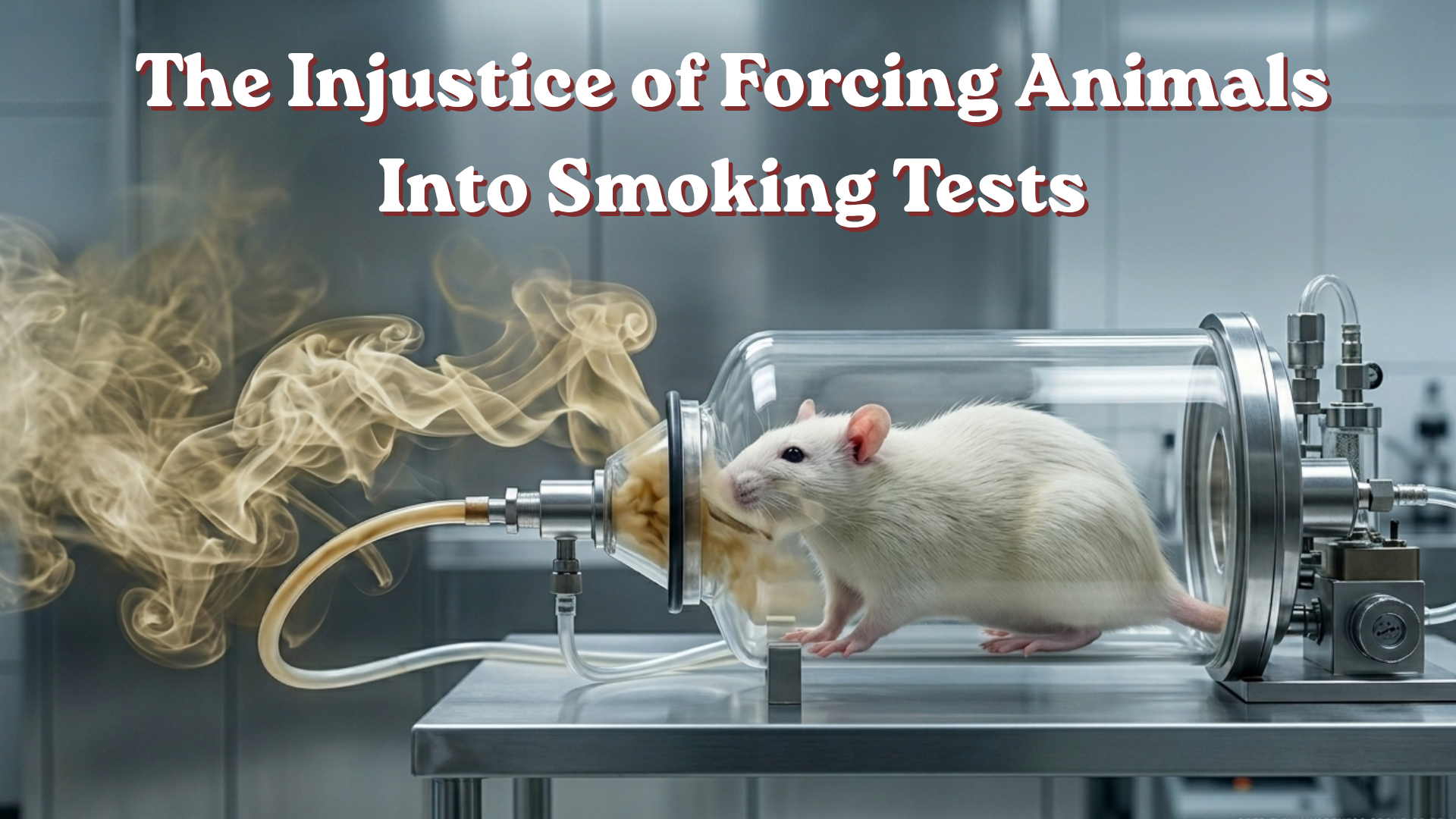
No animal in the wild has ever chosen to light a cigarette. Yet inside laboratories across the world, millions of mice, rats, dogs, and primates are forced to inhale tobacco smoke — not by choice, but by human hands. This is the hidden, uncomfortable truth about tobacco testing: it is cruel, it is scientifically flawed, and most people have absolutely no idea it is still happening.
- 2M+ Animals used in inhalation toxicity tests every year worldwide
- 6 hrs Daily smoke exposure forced on rats in lab experiments
- 2 yrs Maximum duration of some forced-smoke experiments on rodents
- 6+ Countries that have already banned tobacco tests on animals

This infographic highlights cruel historical tobacco experiments in which rabbits and monkeys were used in smoking-related animal tests.
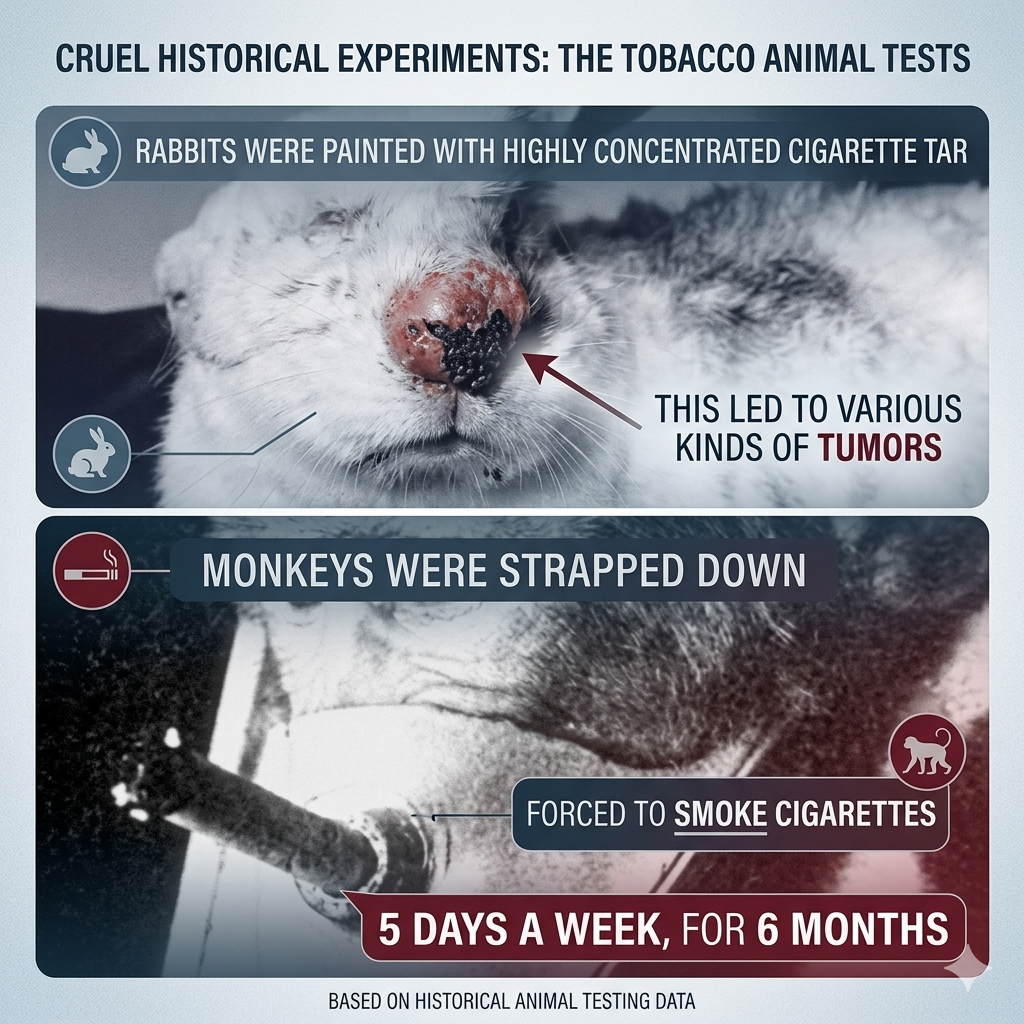
Table of Contents
What Is Tobacco Animal Testing?
The practice that most people never hear about
Tobacco animal testing refers to laboratory experiments in which animals — primarily rats and mice, but historically also dogs, monkeys, and other species — are deliberately exposed to cigarette smoke, nicotine, e-cigarette vapour, and tobacco-derived chemicals. These experiments have been conducted since as far back as 1911 and continue to this day, despite overwhelming evidence that they produce results that are poor predictors of what actually happens in the human body.
The tobacco industry has long used these tests to evaluate the toxicity of new and existing products. In the most common modern form, rats are sealed inside small canisters and forced to breathe cigarette smoke or e-cigarette vapour for hours at a stretch, day after day, sometimes for months or even years — before being killed and dissected to examine the damage inflicted.
What actually happens in these labsIn some experiments, cigarette tar is painted directly onto the bare, shaved skin of mice and rats to induce tumours. In others, animals are locked into restraint devices while tubes pump smoke into their airways. These are not rare edge cases — they are standard practices still occurring at universities and contracted testing facilities worldwide.
Why Animals and Humans Are Not the Same
The scientific case against animal tobacco testing
One of the most damning facts about tobacco animal testing is this: it was animal testing that actually obscured the link between smoking and lung cancer in humans for years. Experiments on rats and mice repeatedly failed to produce lung cancer from cigarette smoke — leading to early, incorrect conclusions that tobacco was not definitively carcinogenic. This happened because rodent lungs are simply not a reliable model for human lungs when it comes to smoke inhalation.
The biological differences are significant and well-documented. Rats breathe exclusively through their noses, while humans can breathe through both the nose and mouth. Rats also breathe at a much faster rate and live close to the ground, meaning their nasal passages are evolutionarily adapted to filter out particulates far more efficiently than a human nose. A rat’s smaller nasal anatomy also prevents the inhalation of larger particles that readily enter human airways and lungs.
The bottom line is straightforward: forcing an animal that never smokes by choice to inhale smoke in an artificial laboratory setting tells us very little about what a lifelong human smoker will experience. Different species metabolise toxins differently, respond to carcinogens differently, and develop diseases on entirely different timescales. Bad science harms both the animals in the laboratory and the humans who rely on accurate health data to make decisions about smoking.
A Timeline of Tobacco Testing on Animals
From the 1900s to today
- 1911 First recorded attempts to artificially induce tumours in animals using tobacco products are conducted in laboratory settings.
- 1960s–70s Beagles and other dogs are used extensively in cigarette testing. Shocking undercover photos of “smoking beagles” surface in 1975, sparking public outrage in the UK and beyond.
- 1990s–2000s Primates are used in six-hour daily smoke inhalation studies. A 2015 university study forces monkeys to inhale cigarette smoke for an entire year — only to confirm findings already documented in human patients in 1992.
- 2009–Present The US FDA gains authority to regulate tobacco products. While animal testing is not legally required, regulators can suggest it during product approval — meaning the practice continues despite the availability of superior alternatives.
- Today Over 2 million animals are estimated to be used annually in inhalation toxicity testing worldwide. Rats and mice are the primary victims, subjected to smoke, vapour, and chemical exposure on an industrial scale.
Countries That Have Already Said No

Where tobacco animal testing is banned
Several progressive nations have already recognised that tobacco animal testing is both ethically indefensible and scientifically unnecessary, and have moved to ban it entirely. These countries demonstrate that meaningful regulation of tobacco products is entirely possible without harming a single animal.
- 🇩🇪 Germany
- 🇧🇪 Belgium
- 🇬🇧 United Kingdom
- 🇪🇪 Estonia
- 🇸🇰 Slovakia
- 🇳🇱 Netherlands
Notably, Philip Morris’ own German laboratory has developed in vitro methods using human lung tissue to test tobacco products — proving that the tobacco industry already possesses the capability to move away from animal testing entirely. The question is not whether it is possible. The question is whether there is sufficient will to make it happen everywhere.
Humane Alternatives That Actually Work
Modern science has better options — for animals and for accuracy
- 3D Human Tissue Models: Three-dimensional respiratory tract tissue models built from human cells can be exposed to smoke and vapour, providing human-relevant data that animal models simply cannot replicate. Cells from donors of different ages, sexes, races, and smoking histories can all be incorporated.
- In Vitro Cell Culture Testing: Laboratory tests conducted on human cell cultures allow researchers to study the toxic effects of tobacco chemicals at the cellular level, without subjecting any living creature to suffering.
- Human Epidemiological Data: Decades of population studies, clinical records, and health surveillance data from human smokers provide an enormous, evidence-rich body of knowledge that makes much of new animal testing entirely redundant.
- Computational Modelling: Advanced computer simulations can model how tobacco chemicals interact with human biology, offering fast, repeatable, and cost-effective data generation without any animal involvement.
What You Can Do to Help
Take Action for Animals
Awareness is the first step. Share the truth about animal tobacco testing with friends, family, and on social media — most people are shocked to learn it is still happening.
Support organisations like PETA Asia, which funds the development of non-animal test methods and actively lobbies global regulatory agencies to adopt modern, humane alternatives.
Choose to purchase tobacco products only from companies that have committed to eliminating animal testing — and, if you smoke, consider this yet another powerful reason to quit. Your choice protects not only your own health, but the lives of millions of animals who never chose to smoke at all.
Write to your government representatives and urge them to follow the lead of Germany, Belgium, and the UK — countries that have already banned tobacco product testing on animals through legislation.
Finally
Animals didn’t start smoking. We should stop making them.
The Redmi A7 Pro 5G may be the must-have gadget of the month, but the must-have shift in human consciousness is this: recognising that animals are not laboratory equipment. They feel pain. They experience fear. And no amount of corporate profit or regulatory convenience justifies sealing a rat in a canister and pumping cigarette smoke into its lungs for six hours a day, year after year.
The science is clear. The alternatives exist. The bans are spreading. What remains is the moral urgency to demand that every country, every regulatory body, and every tobacco company chooses compassion over convention — and acknowledges, once and for all, that animals don’t smoke. So we must stop forcing them to.


